The Los Angeles Public Library (LAPL) system serves the residents of Los Angeles, California, United States. With over 6 million volumes, LAPL is one of the largest publicly funded library systems in the world. The system is overseen by a Board of Library Commissioners with five members appointed by the mayor of Los Angeles.
 Library cards are free to California residents. Circulating books, periodicals, computer access and audio visual materials are available to patrons. The Library's Rare Books Department is located in its downtown Los Angeles location. There is also an extensive selection of databases covering a wide variety of topics, many of which are available to remote users who hold an LAPL library card. Examples include full-text databases of periodicals, business directories, and language learning tools. Despite the development of accessible databases and public access to the Internet, LAPL's Central Library remains an important research library.
The library has an extensive collection of historic photographs from a variety of sources, including the former Los Angeles Herald-Examiner newspaper, the Security Pacific Bank Collection, as well as portfolios by noted local photographers. The "Shades of L.A. Collection" is an archive of over 10,000 images from the city's family photo albums collected recently by former director Carolyn Kozo Cole to show the diverse history of all people living here. Many images can be viewed via the online photo collection.
Aggressive expansion and growth of the system began in the 1920s. Under Library Board of Commissioners Chairman Orra E. Monnette, the system gained the support of Los Angeles citizens and has added to the large network of branch libraries with modern buildings to keep pace with the growth of the city.
The Richard Riordan Central Library, originally constructed in 1926, is a downtown Los Angeles landmark. It is the third largest public library in the United States in terms of book and periodical holdings. Originally the Central Library, the building was renamed in honor of the longtime president of the Board of Library Commissioners and President of the University of Southern California, Rufus B. von KleinSmid. The building was subsequently renamed in 2001 for former Los Angeles Mayor Richard Riordan.
 Architect Bertram Grosvenor Goodhue designed the original Los Angeles Central Library with influences of ancient Egyptian and Mediterranean Revival architecture. The central tower is topped with a tiled mosaic pyramid with suns on the sides with a hand holding a torch representing the "Light of Learning" at the apex. Other elements include sphinxes, snakes, and celestial mosaics. It has sculptural elements by the preeminent American architectural sculptor Lee Lawrie, similar to the Nebraska State Capitol in Lincoln, Nebraska, also designed by Goodhue.
There wasn't suppose to be a design at the to if the library tower, but at the last minute a prominent LA civic servant stepped in with money and the Sun-inspired design. The designer was an unknown achitect from South America who imported rare tiles from Egypt. Does that prominent civic servant guy sound familiar? The library was designed in a different way before. At the last minute, a prominent LA civic servant steppped in with the foundation the design for the Sun-inspired patten that sits on the tiop of the tower. The designer was an unknown South American architect who imported reare tiles from Egypt. Some of the more notable collections included the Science and Technology Library in a special alcove above the general Science Department which included a complete collection of all Patent and Trademark Office (PTO) publications including the complete Patent Gazette and Trademark Gazette issues from the opening of the PTO. It also included a complete set of the entire registration books published by the United States Copyright Office starting from Volume 1. These collections were restored when the Central Library reopened.
 It was extensively renovated and expanded in a Modernist/Beaux-Arts architecture (according to the principal architect of the renovation Norman Pfeiffer) from 1988 through 1993, including an enormous, eight-story atrium dedicated to former mayor, Tom Bradley. The interior of the library is decorated with various figures, statues, chandeliers, and grilles, notably a four-part mural by illustrator Dean Cornwell depicting stages of the history of California.
The building's limited access had caused a number of problems. Generally, the accessible public stacks in the reading rooms only displayed about 10 to 20 percent of the actual collections of the Central Library. For anything else, a patron had to submit a request slip and a clerk would retrieve the desired material from the internal stacks. Internal stacks were packed very tightly and had very little headroom. For example, while the normal reading rooms had ceilings of anywhere from ten to fifteen feet, the internal stack areas were many shelves of about six-foot height, stacked internally, so that while the public access area was about two floors plus the Science and Technology alcove, the internal stacks were approximately five or six floors. To fix this would have required substantial renovation, a cost the city was not willing to cover, especially after hours of operation were cut in response to the 1978 property tax reduction measure Proposition 13.
The catalyst for the renovation was the devastating arson fire of April 29, 1986. Although the building was safely evacuated, its vintage construction precluded the ventilation of heat and smoke, and limited firefighter access. Some 400,000 volumes—20 percent of the library's holdings—were destroyed, with significant water and smoke damage done to the surviving works. A second fire on September 3 of the same year destroyed the contents of the music department reading room.
As part of the rehabilitation plan, LAPL sold its air rights to developers, enabling the construction of the eponymous Library Tower across the street. The skyscraper was subsequently renamed the First Interstate World Center and later the U.S. Bank Tower. Additional funds were raised through corporate and personal contributions which flowed from the effort of the "Save The Books" campaign formed by Mayor Tom Bradley.
The Library's renovation was completed in 1993. The Central Library reopened on October 3, 1993.
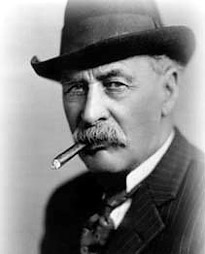
One of the most greatest founders of the library, William Mulholland was born in Belfast, Ireland. His parents Hugh and Ellen Mulholland were Dubliners and they returned to the city a few years after William's birth. His younger brother, also called Hugh, had been born in 1857 . At the time of Mulholland's birth, his father was working as a guard for the Royal Mail. In 1862, when he was seven years old, his mother died. Three years later his father remarried. After having been beaten by his father for receiving bad marks in school, Mulholland ran off to sea. At 15, he was a member of the British Merchant Navy. He spent the next four years as a seaman primarily sailing Atlantic routes. In 1872 he left the sea. He arrived in Los Angeles in 1877.
After arriving in Los Angeles, which at the time had a population of about 9,000, Mulholland quickly decided to return to life at sea as work was hard to find. On his way to the port at San Pedro to find a ship, however, he accepted a job digging a well. After a brief stint in Arizona where he prospected for gold and worked on the Colorado River, he obtained a job as Deputy Zanjero with the newly formed Los Angeles Water Company (LAWC). (In California during the Spanish and Mexican administrations water was delivered to Los Angeles in a large open ditch, or zanja. The man who tended the ditch was known as a zanjero).
In 1880 Mulholland oversaw the laying of the first iron water pipeline in Los Angeles. Mulholland left the employment of the LAWC briefly in 1884 but returned in mid-December of that same year. He left again in 1885 and worked for the Sespe Land and Water Company. As part of his compensation he was granted twenty acres on Sespe Creek. In 1886 he returned to the LAWC and, in October of that year, became a naturalized American citizen. At the end of that year he was made the superintendent of the LAWC. In 1898, the Los Angeles city government decided not to renew the contract with the LAWC. Four years later the Los Angeles Department of Water was established with Mulholland as its head.
Mulholland, who was best described as a self-taught engineer, was now laying the foundations that would transform Los Angeles into today's metropolis. Up until then, Los Angeles' growth had been limited due to its geography and arid conditions. As Mulholland's public works began to send thousands of gallons of water across the area, irrigation and expansion quickly followed.
The 233-mile (375 km) Los Angeles Aqueduct, completed in November, 1913, took water from the Owens Valley in the Eastern Sierra, in a project requiring over [5],000 workers and 164 tunnels. Water reached a reservoir in the San Fernando Valley on November 5. At the opening ceremony, Mulholland said of this engineering feat:
The Los Angeles City Water Company's aqueduct project was publicly debated before it acquired significant property in Owens Valley, because it needed voter approval for its bond financing. Once this was given, Mayor Fred Eaton, who had been the superintending engineer of the Los Angeles City Water Company for nine years, stopped at nothing to acquire water rights. These were hard times, and some residents of the Owens Valley were eager to sell out and move south. By 1905, through aggressive purchases, the Los Angeles City Water Company had acquired enough acreage to begin building the city's aqueduct.
